


It is Friday morning. My internet has gone out eighteen times in the past hour and a half, I have repeated the same stories enough times that I am starting to forget which version I already saved, and I am tired as ever. So naturally, this is the perfect time to write an article about professionalism. Today I am going to talk about ethical contracting, frontline leadership, workplace discipline, and the line between operational hardship and the preventable problems leadership creates. Near the end, I am also going to return to a short email that landed in my inbox at 8:59 p.m. last night, because small interactions can reveal more about an organization than the polished statement on its website.
Do your job and take care of people. That applies when you send an email, recruit forty people in two days, submit a proposal, run a shift, visit a site, command a ship, or sit in an executive office explaining why the numbers do not work. I understand being overloaded, bad contracts, billable hours, staffing shortages, red lines, last-minute missions, double shifts, mistakes, and workdays that somehow become recruiting, logistics, training, personnel management, and half of accounting before lunch. None of it excuses treating people like they are beneath you. A difficult job can explain why something took longer than it should have. It does not excuse contempt, dishonesty, indifference, or bad leadership.
A Bad Contract Does Not Excuse Bad Leadership
I used to recruit for large security contracts, and I have been handed missions that sound unreasonable: fifteen qualified people in less than twenty-four hours, forty in roughly two days, and hundreds for major events. These were not names on a spreadsheet. They needed credentials, equipment, paperwork, training, and actual availability. When thirty candidates produced eight people ready to work, somebody still had to fill the shift. I would work twelve-hour days because the mission did not change even when the pipeline failed. Even then, the applicants were still people. I might say, “Hey, big dog, I got a lot going on. You’re gonna have to be here for a while, but I’m gonna get to you.” It was direct, honest, and gave that person a clear expectation. If your staff treats an ordinary applicant poorly but straightens up for the chief executive, they have already told you what the culture is.
At another large company, I inherited a contract with chronic understaffing, terrible retention, and low pay. Sergeant O’Connor at Triple Canopy taught me to know policy well enough that nobody could manipulate it or blame me for somebody else’s failure, so I did what I have done everywhere else: studied the contract and built a plan. A senior executive showed me the red line and said I was good if I stayed under it. Good to go. I coordinated with experienced people on both shifts, stayed under the line, and refined the plan until it required no additional spending. When I presented it, he answered with his résumé and certifications instead of discussing the plan. If staffing and retention are collapsing, the paper on the wall does not mean much. Once the people with authority decide the system will not change, good employees either accept the dysfunction or leave. I left. Apparently, in his words, I left “like a thief in the night.”
The same rule applies when a company bids on work. A new business can misjudge its first contract, own the mistake, absorb the loss, and learn. A national company with experienced contracting departments does not get the same excuse. If a contract cannot support reasonable staffing, accurate pay, relief, breaks, training, and the tools needed to perform, walk away. At Eight Point Solutions, I would rather lose revenue than attach our name to work we cannot deliver ethically. I know what it is like to lose a bid and wonder how rent will get paid, but I cannot solve my cash-flow problem by creating a life problem for somebody else. Employees are not margin entries. If you are the kind of leader who forgets that, remember this: whether you run a one-person company or a one-million-person company, your title and margins are temporary. You are going to die, and hopefully your bad ideas die with you. What remains is what your decisions did to people.
Leadership Has to Leave the Office
That standard does not end when the contract is signed. The numbers can look fine from an office while the people carrying it miss relief, wait on training, and absorb failures created above them. Leadership has to visit the site, listen to the people doing the work, and act. That is why I still speak highly of Constellis and Triple Canopy, and always will. No company is perfect, but at Camp Arifjan and Camp Buehring, my recommendations were heard. I directed the Field Training Officer program and stayed for long days because improvements went somewhere. The training department listened, changes were adopted, and people saw an outcome. People work extremely hard when they believe the effort matters. The quickest way to kill that commitment is to ask for their judgment, ignore it, and remind them about your résumé. If a good employee stops bringing you ideas, look at what happened the last few times that person spoke.
I also give Allied Universal credit when its leaders go into the field. Brian Block described meeting William and Kiana during a Houston site visit, and Justin Mason has described random site drop-ins around Washington, D.C., to hear directly from personnel. Those visits matter, but they are the beginning, not the conclusion. A photograph cannot tell you whether the schedule is stable, pay is correct, relief arrives, or supervisors follow policy. In 2023, the Department of Labor announced that Allied agreed to pay nearly $1.1 million in back wages and liquidated damages to 778 employees after investigators found meal periods had been automatically deducted even when employees stayed at their posts or worked through them. That does not prove every Allied operation is bad or erase good work in individual regions. It proves recognition and accountability have to exist at the same time.
When a leader visits a site and asks, “What would make your job easier?” that is not enough. Ask whether schedules are consistent, pay is accurate, relief arrives, people can eat and use the restroom, supervisors follow policy, and whether retaliation or drama is poisoning the shift. Some security assignments are supposed to be simple. Poor recruiting, delayed training, missing relief, and bad supervision make them unnecessarily difficult, while the frontline security contractor absorbs failures created by management. When the culture turns bad, identify the people responsible, hold the supervisor accountable, and replace an entire shift only when misconduct has become shift-wide and continues after clear notice. Leaders also have to accept correction. One of my instructors once raised a legitimate issue in a tone that irritated me. I took a breath, listened, told him he was right, apologized, and fixed it. I did not enjoy the conversation, but the organization improved because he had the conversation with me. That is the job: hear people, be fair, and enforce standards.
Hardship Is Not Mismanagement
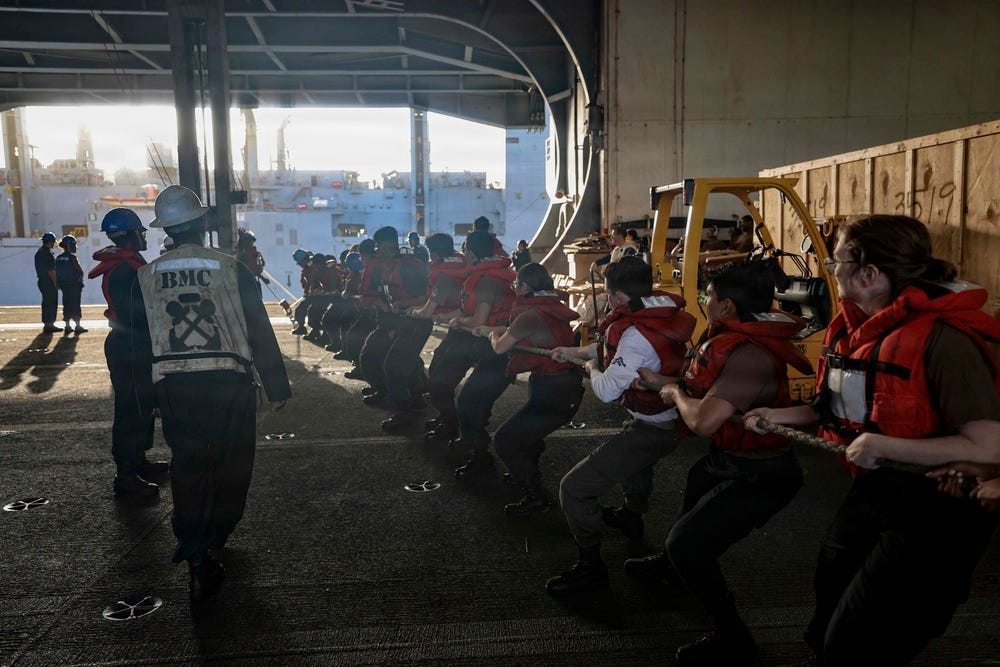
When I first heard the complaints about USS Abraham Lincoln spending months without a port call, along with repetitive meals, delayed mail, boredom, and exhaustion, my reaction was that they were deployed and needed to do the job. Deployment is not a cruise. Missing home, eating the same food, losing privacy, and spending months at sea come with the mission. I volunteered in Eastern Europe and went close to two weeks without normal food. For several days I ate pasta and salt because that was what I had, and eventually my stomach felt like somebody was twisting my intestines. I was unpaid, there voluntarily, and still had work to do. Sailors should not live on pasta and salt. The point is that discomfort is not automatically injustice.
The line became clearer when I read that sailors across the surface fleet averaged 5.25 hours of actual sleep each day, below the Navy standard of at least 7.5 hours available for sleep. That Government Accountability Office finding is not Lincoln-specific, but it is a Navy leadership problem. GAO reported that the Navy cited fatigue in the loss of an F/A-18 Super Hornet and the USS Harry S. Truman collision. The Lincoln left San Diego on November 21, 2025, stopped briefly in Guam in December, and then remained at sea. By August 20, when USS George Washington arrived to relieve it, the Lincoln had been deployed for more than 270 days, including more than 250 without a port call. Families and sailors raised concerns about basic supplies, plumbing, mail, sanitation, and mental health. The Navy disputed several allegations, acknowledged mail disruptions and changes to resupply, and said it had not identified an increase in reported suicidal ideation or attempts. Allegations should not become facts just because they support an argument, but the confirmed fleet-wide fatigue problem is enough to demand attention.
The dividing line is straightforward. Endure the hardship that comes with the mission, but do not accept preventable degradation created by bad leadership. Repetitive chow and delayed mail are hardships. A schedule that prevents adequate sleep is a leadership failure. Unsafe water, unresolved sanitation, or retaliation for reporting problems would be leadership failures if verified. Individual responsibility still matters. Some members of this generation have become less tolerant of ordinary discomfort, and constant attachment to a phone does not help. I put my phone away during meals and when I spend time with people because I know constant stimulation does not help my discipline, rest, or mental health. Leadership has to create real opportunities to sleep, recover, and communicate with home. Individuals still have to use them. We can expect people to be tough and still expect leaders to do their jobs.
The Email That Started This
All of that brings me back to the email from 8:59 p.m. last night. I have been doing outreach to workforce programs, private companies, recruiters, training partners, and anybody else Eight Point Solutions may be able to help. I do not grab a list and spread the same garbage across a thousand inboxes. I research the company, look at what it is hiring for, identify the problem, and decide whether we can help before I write the email. Then I read it again, change a word because I do not like how it sounds, look up a synonym because apparently I enjoy making my own life difficult, and make sure it is professional without sounding like it was written by a lawyer with a PhD. Eventually, I hit send.
Every now and then, somebody answers with something like, “Not interested, please unsubscribe me.” I did not subscribe you to anything. I sent you an email. The response does not ruin my life, but it tells me something about the person and probably the organization. A professional response takes five seconds: “Thanks, but we already have a program in place. Take care.” You do not have to compliment me, schedule a meeting, or pretend we might work together one day. You can simply just say no, like a normal adult. Microsoft reported that the average worker in its aggregated, anonymized Microsoft 365 telemetry received 117 emails a day, with most messages skimmed in under a minute. People are overloaded. That explains a delayed response, a short response, or no response at all. It does not explain choosing to be dismissive.
If you do not have the bandwidth to answer with common courtesy, do not answer. I recently answered a gentleman after nearly a month because my schedule had become unreasonable. I apologized, answered his question, and we kept it moving. The difference between overload and bad leadership is not response time. It is whether you recognize that another human being is on the other side of the exchange. A short email will not destroy a company, but small interactions reveal culture. If somebody is dismissive when nothing is at stake, I do not expect that person to become more thoughtful when the stakes get higher.
The Standard Applies to Me
It is easy for me to write this while Eight Point Solutions is still small. Somebody could tell me to wait until I am responsible for a thousand employees and one contract is keeping the company alive. Fair. Save this article. If EPS becomes large and I stop visiting the people doing the work, accept contracts we cannot deliver ethically, protect a friend or family member who cannot perform, punish somebody for raising a legitimate concern, or start talking about credentials while outcomes collapse, quote it back to me. If the facts support the criticism, I should hear it. If I abandon these values, I should resign. And you can quote that.
Taking care of people does not mean excusing nonperformance. Last November, I brought on roughly seven people for a project. When concerns surfaced about the work, I did not fire anybody. I did not even believe the initial report. I waited a week and hired an independent investigator to audit our records because I did not want anybody to dismiss the conclusion as my bias. The independent audit found that the required deliverables had not been completed and that the failure contributed to approximately $17,000 in lost revenue. That is when I became angry. I had given people an opportunity, and they had taken advantage of it at the company’s expense. For months afterward, some of the people involved disputed what the records showed. Accountability required me to document the findings and act according to the written agreements. Fair leadership protects people from abuse, but it does not erase performance standards.
Leadership is not giving everybody whatever they want. Not everybody gets promoted, nobody is exempt from discipline, and not every contract will be profitable. Leadership is telling the truth, knowing the policy, accepting correction, making a decision, and owning the outcome. It is refusing to manufacture preventable hardship and rename it resilience. It is remembering that the people carrying your contracts, staffing your shifts, serving aboard your ships, answering your emails, teaching your students, and keeping your organization alive are people before they are numbers. Do your job. Take care of your people. Do not become the problem.
It is still Friday morning, I am still tired as ever, and my internet may disappear again before I hit publish. None of that changes the standard. Professionalism is easiest when you are rested, fully staffed, profitable, and speaking to somebody who can help you. Leadership is what you do when none of those things are true. Answer people with basic respect, staff the contracts you agreed to perform, correct problems before your employees have to carry them, and own the outcome. If one short email brought somebody specific to mind, that conclusion belongs to you. I have a company to run.
References
This assessment incorporates open-source intelligence monitoring via Monitor The Situation (monitorthesituation.org); Microsoft WorkLab’s “Breaking Down the Infinite Workday” (microsoft.com, June 17, 2025); Brian Block’s Houston site-visit post (LinkedIn, April 30, 2025) and Justin Mason’s Washington, D.C., site-engagement post (LinkedIn, September 26, 2025); U.S. Department of Labor reporting on automatic meal-break deductions affecting 778 Allied Universal employees (dol.gov, October 20, 2023); Senator Richard Blumenthal’s August 12 letter concerning the Lincoln deployment, U.S. Pacific Fleet reporting on the carrier’s December 11 arrival in Guam, and DVIDS documentation of its December 12 departure; Stars and Stripes reporting on USS Abraham Lincoln’s 207 consecutive days at sea (stripes.com, July 9, 2026), Navy Times reporting on congressional questions about conditions and deployment extensions (navytimes.com, August 13, 2026), and Associated Press reporting on USS George Washington’s arrival to relieve the Lincoln (apnews.com, August 20, 2026); U.S. Government Accountability Office reporting on sailor fatigue in the surface fleet (gao.gov, October 11, 2023) and military readiness challenges across the air, sea, ground, and space domains (gao.gov, March 4, 2026); and the public-domain U.S. Navy photograph “Abraham Lincoln Conducts Replenishment at Sea” by Mass Communication Specialist 2nd Class Gabriel Fields (DVIDS, February 18, 2026).
About the Author
Kawika Rogers is Managing Partner at Eight Point Solutions LLC, a veteran-led defense consulting and training firm based in Maryland. He served as an Infantry Team Leader in the United States Marine Corps, then directed the Field Training Officer program and served as an Armorer for Triple Canopy at Camp Arifjan and Camp Buehring in support of Operation Inherent Resolve. He has also served in an advisory and operational capacity in Eastern Europe. Rogers holds over 15 instructor certifications in firearms, defensive tactics, and emergency medicine, and studied International Relations and Global Security at American Military University.
Eight Point Solutions LLC 7404 Executive Place, 5th Floor, Suite L-17, Lanham, MD 20706 rogers@eightpointsolutions.com // eightpointsolutions.com SDVOSB // SAM UEI: EY34ARER2TD9
This assessment is based on publicly available, open-source intelligence. It does not contain classified information. Distribution is authorized for public release.